
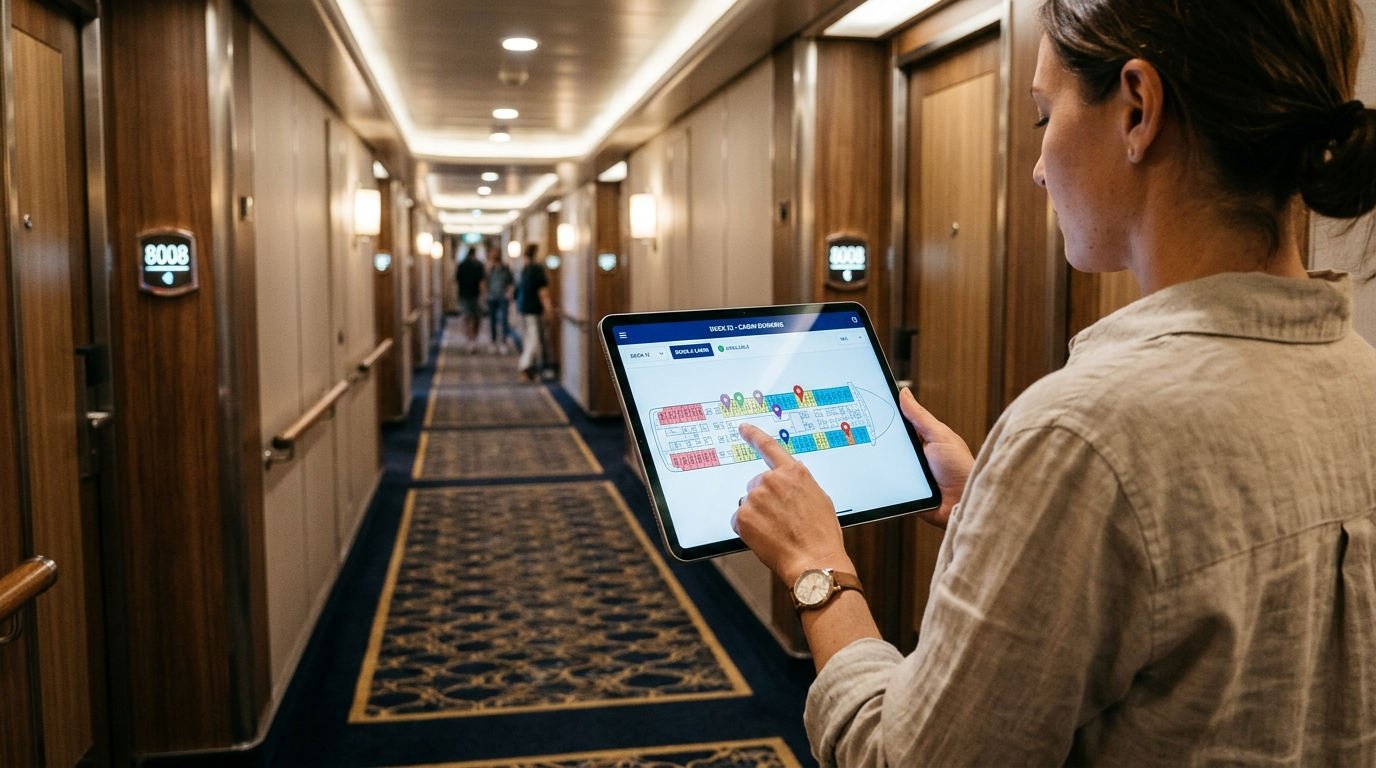
A deck plan is the most useful reality check between the cruise brochure and the room you will actually occupy. It reveals where noise may travel, how far you will walk, and whether a supposedly attractive cabin has an obstruction or unusual configuration. You do not need to understand shipbuilding to read one well; you need to investigate the routes and neighbors that will shape your day.
Find the exact vessel and version
Cruise lines sometimes operate sister ships with similar names, and individual vessels may have been refurbished or reconfigured. Confirm the ship's full name and your sailing date before relying on a diagram. A deck plan from an older brochure may not show newer dining venues, cabin changes, or renamed facilities.
Start with the official deck plans provided by the line. Look for a legend explaining cabin colors, connecting rooms, accessible staterooms, blocked views, and occupancy symbols. Third-party plans can help you understand a layout, but they should not override current information from the operator.
Make a note of your actual room number, not just the grade. Two cabins sold under the same category can sit on different decks with different noise exposure, walking distances, or view angles. Knowing the exact location is especially valuable when considering an upgrade or a guaranteed cabin assignment.
Inspect the floor above before the one you're buying
Many cabin disappointments come from something directly overhead. Pool decks may generate sounds from furniture movement and maintenance early in the day. Fitness areas can create intermittent impact noise, while kitchens and service routes may run at unusual hours. Large public venues do not necessarily produce problems, but they deserve extra scrutiny.
A stateroom under another layer of ordinary cabins often has fewer potential overhead disruptions. That is not a guarantee of silence: neighbors, plumbing, and ship operations still exist. It simply removes some obvious sources of activity.
The symbols on the plan become more useful when paired with the differences between inside, oceanview, balcony and suite cabins.
Now look below. Theaters, bars, and lounges can transmit music or vibration upward, particularly if events extend late. If you prefer a very early bedtime, being adjacent to an evening venue may be a poor match even if a particular review reports no issue. Noise tolerance is personal, and conditions change with programming.
Check the walls on either side
A connecting cabin door is an advantage for families who book both rooms. For others it may introduce a potential pathway for sound. Confirm whether the connecting door is locked when rooms are booked separately, and consider a nonconnecting option when privacy is important.
Service closets, steward stations, lift lobbies, and stair landings are worth noticing. A cabin near an elevator can reduce walking, but a door directly opposite a busy waiting area may experience more conversation and footsteps. There is a useful middle ground: close enough for convenience without being on the busiest corner.
Some corridors are through-routes between major public areas. Others end near a small group of cabins and see less passing traffic. Trace the path passengers would take to reach dining, the pool, and the theater. If your door lies on the natural shortcut, you may hear activity even when the stateroom itself is otherwise well positioned.
Read the symbols before assuming who can sleep where
Deck-plan legends often show upper berths, sofa beds, connecting doors, accessibility features, and cabins that accommodate more than two people. Not every sleeping arrangement is equally suitable for adults or young children. An upper berth can require climbing; a sofa bed may reduce usable floor space when opened.
For a family, request confirmation of the exact bed configuration and whether a crib is permitted. Ask how much walking space remains once extra beds are made up. Square footage alone does not reveal how easily guests can move around at night or access the bathroom.
Accessible cabins are more than a symbol. Verify door widths, bathroom arrangement, roll-in shower details, grab bars, bed access, thresholds, and the route to key facilities. Equipment needs and mobility requirements differ. Contact the line's accessibility department before booking if a precise feature is essential.
Understand the view from the room
An oceanview or balcony label does not promise an unobstructed panorama. Lifeboats, structural supports, promenade decks, overhangs, and unusual hull shapes can affect the view. Some views are restricted only when looking down; others can be interrupted at eye level.
Where the deck plan indicates an obstructed view, examine photographs of the specific room or nearby cabins on the same ship when available. Be cautious about relying on images of sister ships: subtle structural differences can matter. A lower-priced obstructed balcony may still be excellent value if you mainly want fresh air, but disappointing if watching distant scenery is the main goal.
Balcony size also changes around curves and corners. An extended balcony may look generous on paper while being visible from public areas or exposed to wind. Check whether the railing is glass or metal and whether the furniture arrangement fits your expectations.
Trace your three most frequent journeys
Choose the places you expect to visit several times a day: breakfast, the main outdoor deck, and a favorite lounge, for example. Trace the walking route from the cabin, accounting for which lifts or staircases actually connect the decks. A room that appears close in a straight line may require a detour around a blocked corridor or venue.
If you have early shore excursions, investigate the route to the gangway or meeting location. On some ships those points change depending on the port. Families may value quick access to youth facilities; travelers who dislike stairs may prefer a cabin beside a lift bank that serves their chosen restaurants.
Do not automatically choose the highest deck. A top-level cabin may be convenient for pool access but farther from dining and theater venues. A lower cabin could offer a shorter walk to the gangway and main indoor spaces. Convenience is always relative to your routine.
Think about motion and location
Guests concerned about seasickness often favor a lower, more central cabin because movement may feel less pronounced there in some conditions. At the front or rear, the sensation can differ, and the route itself matters substantially. Stabilizers and hull design play roles that cannot be seen from a deck plan.
A forward cabin may offer distinctive views but involve a longer walk to some amenities. An aft cabin may appeal for wake views while presenting considerations about vibrations or distance. Read ship-specific accounts carefully and avoid treating isolated personal reports as universal truths.
For cold-weather cruises, getting from the cabin to a sheltered observation lounge may matter more than proximity to an outdoor pool. For tropical routes, quick access to the deck and shaded spaces might be a daily pleasure. Match position to the itinerary, not only the cabin photograph.
Watch for limited-access areas
Some ships reserve lounges, restaurants, sun decks, or priority facilities for particular suite categories. A deck plan may display those spaces without making access restrictions obvious. Confirm which areas your fare permits you to use, and whether reservations or additional charges apply.
Likewise, some attractions have schedules or age and height requirements. A family might choose a cabin near a pool, only to discover the featured facility is not suitable for the youngest child. The map shows where something is; the cruise line's current policy explains whether it works for you.
Compare two candidate rooms methodically
Create a small checklist for each cabin number: likely noise above and below; side neighbors; proximity to lifts; ordinary walking routes; view restrictions; number and type of beds; and any essential accessibility features. If both locations seem acceptable, weigh the actual fare difference against the conveniences you gain.
Before payment, confirm whether your booking guarantees the exact number or only a category. A guarantee fare might assign the room later, potentially in a location you would not have chosen. That uncertainty may be acceptable for a flexible traveler and a bad bargain for someone with strict noise or access needs.
A few careful minutes with a reliable deck plan cannot predict every sound or surprise, but it can identify preventable mismatches. The goal is not a perfect cabin on paper; it is a room that makes the rest of your voyage easier.
Trace three everyday routes before selecting a room
Begin with the path from your cabin to the place you expect to eat breakfast. Check which elevators serve both decks, whether the route requires walking through a casino or crowded public area, and whether stairs are a realistic alternative. Then trace your route to the open deck and the main theater. This simple exercise often reveals inconvenient distances that are invisible in a price comparison.
For a scenic cruise, identify public observation spaces and the side of the vessel your cabin faces. Port and starboard views can change as the ship turns or approaches a harbor, so avoid believing that one side is guaranteed to face every landmark. A wraparound promenade or a forward lounge may offer better flexibility than a narrow private balcony when the scenery shifts rapidly.
Pay attention to symbols and footnotes. Deck plans can mark connecting cabins, obstructed balconies, berths that fold down, accessible staterooms, and areas reserved for particular guests. Some public areas are included in the fare; others require reservations or an additional package. A beautiful image of a private retreat may look like a general pool area unless you read its label.
Finally, compare the deck plan with a recent photograph of the ship itself. Renovations can change lounge functions and cabin numbering. Before payment, verify the deck plan edition used by the operator and the details on your specific booking. A screenshot can be useful for your records, especially if you are choosing a cabin to avoid a particular noise source or to stay near someone in your group.
Read a deck plan with a purpose
- Locate your exact cabin between the decks above and below it.
- Check elevators, stairways, service areas and night-time venues near the room.
- Confirm any partial-view obstruction, adjoining door or accessible feature with the operator.