An accessible cruise is possible only when the entire journey works, from the terminal to the cabin, restaurants, outdoor decks, tenders, and transport ashore. A ship may have accessible staterooms while presenting barriers elsewhere. Good planning therefore starts with specific requirements and direct confirmation, not a general promise that a vessel is “wheelchair friendly.”
Define what access means for your journey
Travelers have different needs. One guest may require a roll-in shower and sufficient space for a power wheelchair to turn. Another can walk short distances but cannot manage stairs or stand in queues. Someone with limited hearing or vision may need different forms of assistance. A companion's support does not replace the ship's responsibility to describe its facilities accurately.
List the essential features before comparing itineraries. Record the width and weight of mobility equipment where relevant, transfer requirements, restroom needs, and whether assistance is needed on shore excursions. This helps the cruise line's accessibility team answer practical questions rather than issuing a general description.
Consider the complete door-to-door experience: airport, hotel, transfers, embarkation terminal, ship, ports, and return travel. A perfectly accessible cabin cannot solve a transfer service without suitable vehicles or a tender landing that cannot be used safely.
Accessible cabins: beyond the label
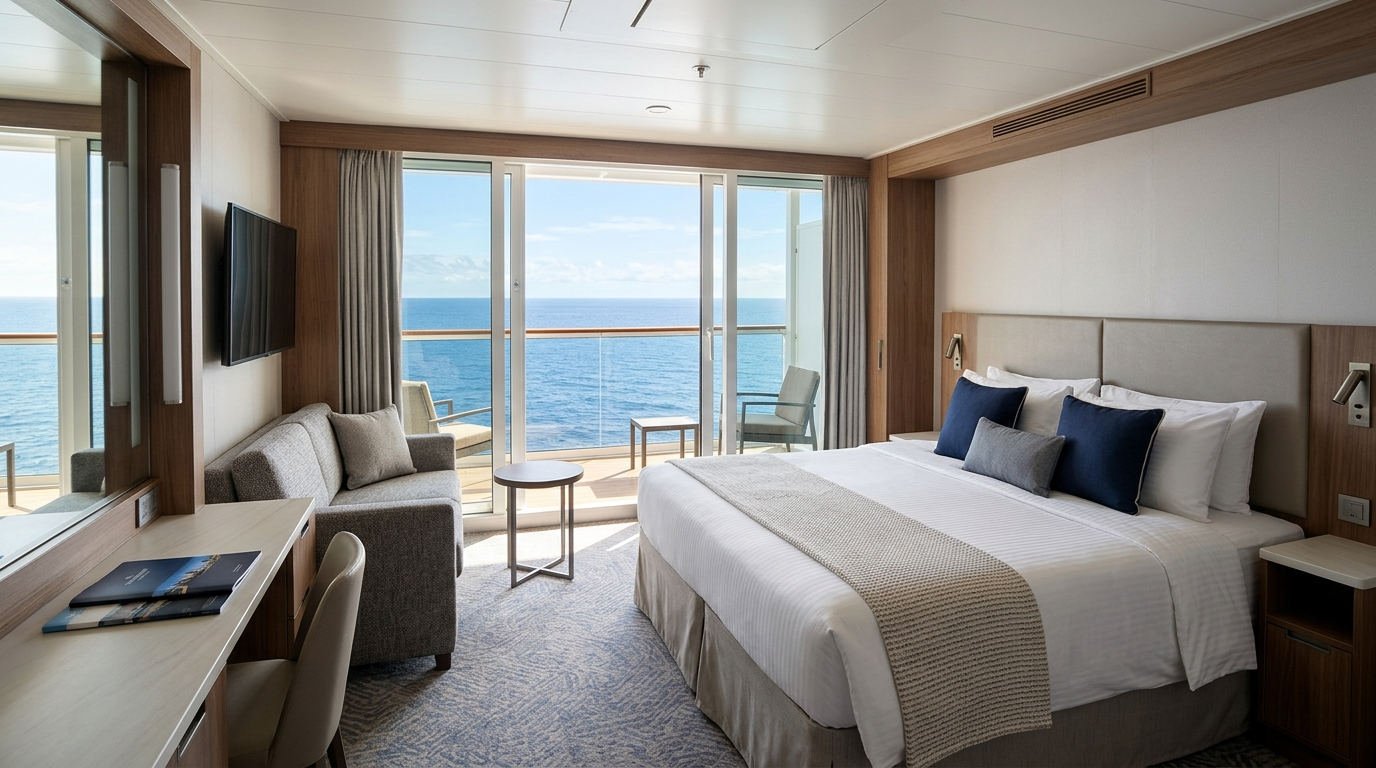
An accessible room may include wider doorways, open floor space, lowered fittings, grab bars, and a roll-in shower. The combination differs by ship and cabin. Verify door clearances, bed height, bedside access, turning radius, bathroom layout, shower seat, threshold dimensions, and whether furniture can be repositioned.
Ask for current photographs or a detailed diagram of the precise cabin number. If a traveling companion needs a separate bed, confirm that opening it will not obstruct wheelchair circulation. A room described as partially accessible may not meet the needs of someone who cannot step into a shower or cross a threshold.
For a careful assessment of accessible routes and neighboring facilities, start with reading deck plans before choosing a cabin.
Accessible cabins are limited in number on many ships. Reserve early when essential, and make sure the reservation notes your actual requirements. Do not assume a cabin upgrade or an assigned-at-check-in category will preserve necessary access features. Confirm any change before accepting it.
Map the route to daily destinations
Elevators are central, but their presence alone does not guarantee a usable route. Trace the journey from cabin to main dining room, buffet, theater, pool area, observation lounge, medical center, and gangway. Look for narrow doors, level changes, heavy doors, or isolated facilities reached by a different lift bank.
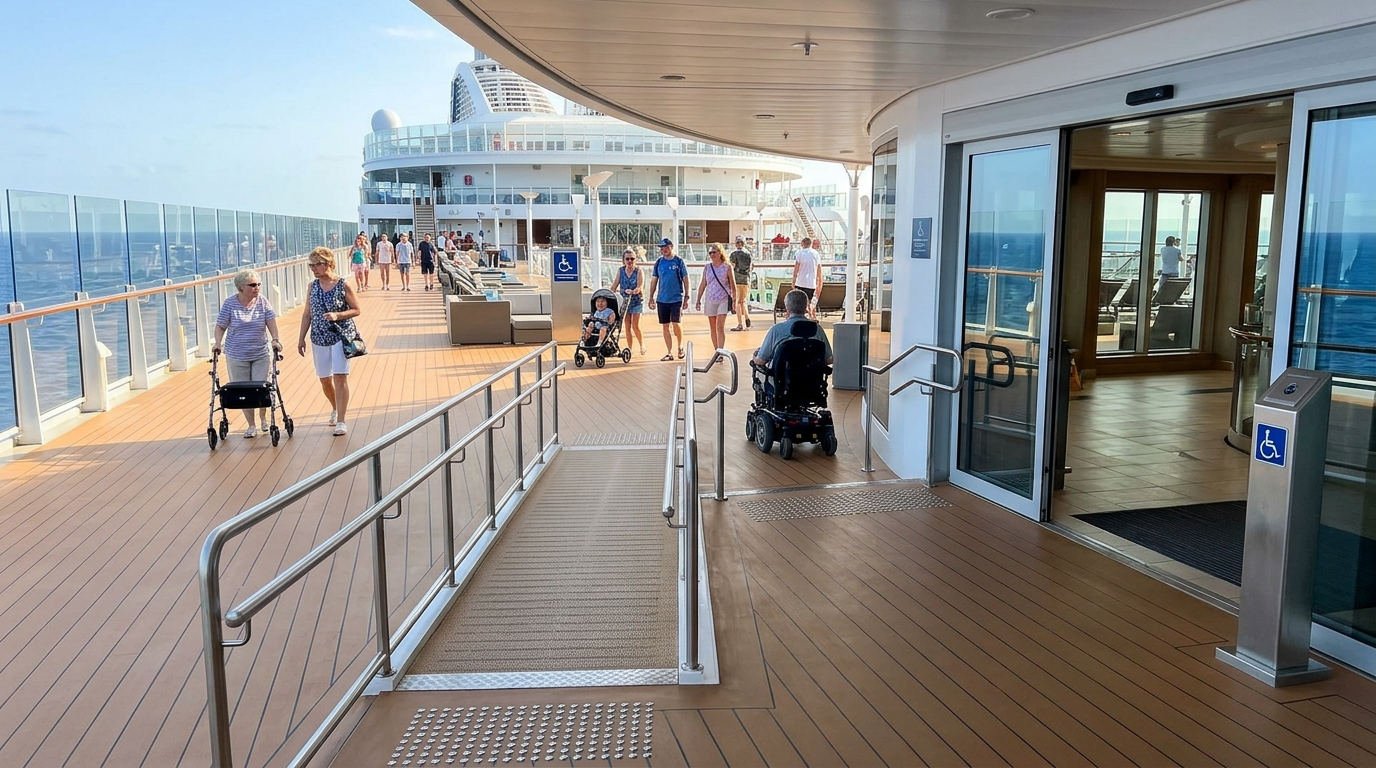
Some deck spaces may be reached by ramps whose slope or width matters. A passenger using a mobility scooter might be able to travel the route while a larger powered chair cannot. Ask for specific measurements where they are important. The official deck plan is a starting point; direct assistance from the operator may be necessary to interpret it.
Think about crowded moments. Elevators can be heavily used before excursions and after performances. A cabin near an appropriate lift may reduce fatigue, though rooms directly beside lobbies can be noisier. Plan extra time for movement instead of building a rigid schedule around optimistic elevator waits.
Embarkation and disembarkation are separate tasks
Arrival at the departure terminal may involve ramps, security screening, queues, and documentation checks. Check the meeting point for accessibility assistance and whether the cruise line needs advance notice. If arriving with a mobility device, verify procedures for boarding and storage, especially for equipment with batteries.
Return-day arrangements can be just as demanding. Guests may be asked to leave cabins early, wait in designated spaces, and move luggage separately. Ask how assisted disembarkation works and whether your onward transport can accommodate a realistic delay.
If you need a particular wheelchair-accessible vehicle, book one directly and confirm its availability in writing. Not every shared airport transfer or local taxi operates with appropriate loading equipment. Cruise-line assistance may start and end at specified points rather than covering every external leg.
Tender ports can be the decisive issue
At some ports, the ship anchors offshore and guests board smaller boats to reach land. Boarding can involve movement between vessels, variable water levels, steps, or equipment limitations. A guest who can easily disembark at a pier may be unable to use the tender safely.
Policies differ by cruise line, ship, equipment, and daily sea conditions. Do not rely on a blanket statement that a destination is accessible. Ask whether the ship offers an appropriate tender boarding system, whether your equipment is compatible, and how decisions are made if weather or swell changes.
Accessible landing at the shore is another consideration. The tender might be usable while the harbor's gangway or streets present obstacles. When port access is essential, favor itineraries with reliably suitable berths where possible, while recognizing that itinerary changes can still happen.
Excursions require a second layer of checking
A shore tour called “easy” may still involve steps, uneven streets, long distances, or a coach without a lift. Ask about the exact vehicle, boarding method, restroom accessibility, walking surfaces, expected distances, and any alternative transport. Terms such as “minimal walking” are too vague when a specific barrier would stop participation.
Travelers can sometimes arrange independent accessible tours, but the operator's experience and backup plan matter. Confirm the meeting point and whether there is sufficient time to return before the ship's all-aboard deadline. A tour that depends on an unavailable accessible taxi creates unnecessary risk.
Research the ports themselves. Historic streets can be cobbled, waterfronts can have steep gradients, and public transport accessibility varies. Some attractions offer excellent facilities; others require advance booking. A realistic itinerary includes the route to and from the attraction, not just the attraction's entrance.
Dining, entertainment and everyday comfort
Check table spacing, buffet access, restaurant entrances, reserved viewing positions, theater seating, and nearby accessible restrooms. An accessible theater position may not be a seat a guest can transfer into, and seating companions may be arranged differently. Ask what is available for the actual party size.
Pool access varies widely. Some ships offer hoists or lifts, while others have only ladders or steps. Fitness centers, spas, and outdoor sun decks may have separate thresholds or equipment limitations. Verify specific facilities rather than expecting all advertised amenities to be available to everyone.
Dietary, sensory, and communication needs deserve attention as well. Guests may need written emergency instructions, visual alerts, help with menus, or quiet space away from amplified entertainment. Request current provisions through the operator and document important arrangements.
Medical support and personal assistance
A ship's medical center is not a substitute for a full hospital or for routine personal care. Medical staffing, equipment, and services vary. Discuss significant health needs with an appropriate clinician before travel, and ask the cruise line what it can accommodate. Travel insurance should be reviewed for medical care, evacuation, and pre-existing condition terms as applicable.
Cruise staff may not be able to provide lifting, dressing, bathing, or other personal assistance. Determine whether a companion or privately arranged caregiver is necessary, and confirm any policies affecting mobility equipment or portable medical devices. Bring medications and critical supplies in appropriate quantities, allowing for possible travel disruptions.
Create a confirmation record
Before final payment, send a concise written list of nonnegotiable access needs to the cruise line and request ship-specific answers. Keep reservation numbers, cabin details, equipment declarations, excursion arrangements, transfer confirmations, and contact information together. Recheck key arrangements if the ship or itinerary changes.
Accessibility is not a single amenity to tick off a booking form. It is a chain of practical routes and services, any one of which can determine whether the vacation works. Choosing a ship where those links are clearly documented gives travelers more independence, comfort, and confidence at sea.
Plan accessibility across the whole journey
An accessible stateroom cannot solve a difficult transfer at the departure port. Before booking, map the journey from airport or train station to hotel, terminal, gangway and cabin. Ask who is responsible for assistance at each handoff and whether reservations are required. Accessible transport can be scarce in some destinations, so confirm a suitable vehicle rather than assuming ordinary shuttle buses will accommodate every wheelchair or mobility device.
At sea, mobility needs affect more than sleeping arrangements. Consider where accessible restrooms are located, whether restaurants offer space to maneuver, and how to reach the theater, pools and observation areas. Some attractions may have independent restrictions based on safety or equipment. A chair lift at one facility does not mean every water-related venue is accessible. Ask precise questions, including whether the equipment will be operating on the sailing you have booked.
Shore arrangements deserve special scrutiny. Some itineraries use tender boats that cannot accommodate every type of wheelchair under all conditions, and weather can affect whether a passenger can safely disembark. A port that docks one year may use tenders on another schedule. If a destination is essential to your trip, request current information about its gangway, shuttle arrangements and excursion accessibility before committing substantial nonrefundable funds.
Communicate needs early, keep written responses, and carry copies of relevant confirmations. Consider a travel companion's ability to assist, the ship's emergency procedures and any medication or medical equipment requirements. Accessibility is not a single yes-or-no ship feature; it is the fit between a person's needs and every stage of the itinerary.
Confirm accessibility in writing
- Ask for measurements and features of the exact accessible cabin you plan to reserve.
- Check gangways, tender ports and shore transport separately from onboard accessibility.
- Tell the operator about equipment or assistance needs within its advance-notice window.