
Adults-only cruising appeals to people who want an atmosphere planned around grown-up interests rather than family programming. But “adults-only” is not a universal legal or marketing definition across the industry. Minimum ages, exceptions, onboard venues, entertainment styles, and dining rules vary. You need to check exactly what the operator means for the sailing you are considering.
Three different ideas are often called adults-only
An entirely adults-only ship generally limits the age of all guests on the vessel. Another cruise may welcome families but operate a private adults-only pool, lounge, or retreat. A third option can be a voyage marketed toward adults—perhaps a longer itinerary or themed departure—without officially excluding children.
Those differences matter. A serene lounge for passengers above a stated age can be enjoyable, yet you will still encounter families in corridors, restaurants, and other public areas. A ship-wide minimum age changes the overall guest mix but does not automatically guarantee silence; the evening program might be energetic and the pool area busy.
Read the operator's policy for the specific ship and sailing. Check whether the minimum age is measured at embarkation, whether exceptional circumstances are possible, and whether particular venues have their own access rules. Never book only because a search result or review describes a vessel as “adult friendly.”
What the onboard day actually looks like
Without substantial youth-programming space, an adults-only ship may devote more public areas to restaurants, bars, fitness facilities, lounges, or relaxation. Some focus on contemporary music, nightlife, and social activities. Others emphasize quiet enrichment, cultural programming, and traditional dining. Two adults-only cruises can feel less alike than two family-friendly ships.
Imagine your ordinary sea day. Would you enjoy a group fitness class and lively poolside music, or a book in a quiet lounge and an early dinner? A cruise line's age restriction tells you who can board, not how your day will unfold. Check daily activity examples and the locations of amplified entertainment.
For a different form of adult-focused atmosphere, consider how themed sailings and hosted events work and the distinction between a full charter and an ordinary cruise.
The ship's size matters, too. A large adults-focused ship may offer many venues and restaurants while remaining energetic. A smaller vessel might create more opportunities for conversation and an intimate atmosphere, though it may offer fewer late-night alternatives. If privacy is important, inspect quiet spaces and cabin locations.
Dining and dress codes shape the social mood
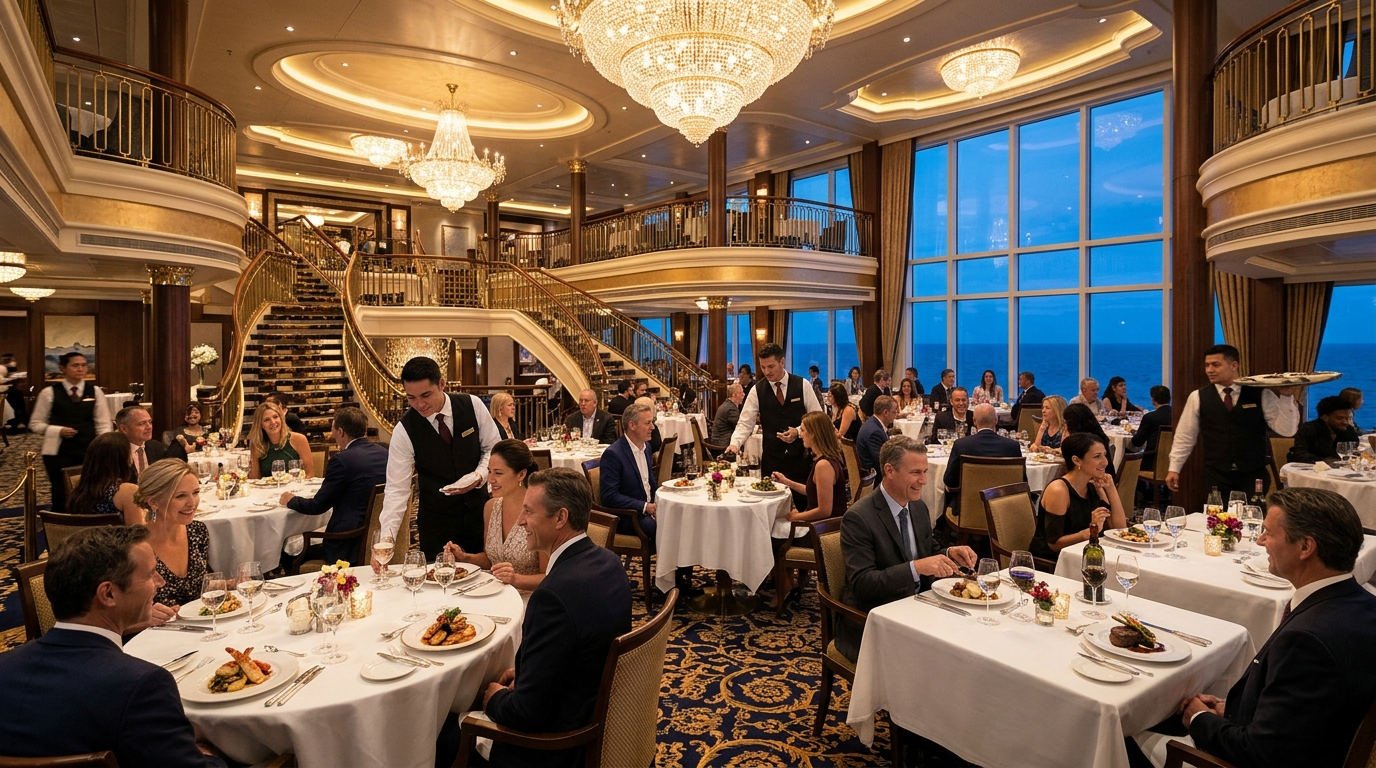
Some adults-focused lines favor flexible dining and informal dress; others preserve formal evenings and assigned dining arrangements. Neither policy follows directly from the adults-only label. Review restaurant hours, whether specialty venues are included, and how reservations work.
A couple traveling for an anniversary may value spacious tables, slow meals, and a distinctive restaurant scene. Friends may prefer walk-in dining and several bars. Solo travelers might appreciate shared tables or hosted events but could feel uncomfortable if the experience is heavily oriented toward couples.
Check menus for dietary options and notify the line of allergies through the official process. Do not assume a premium price or an adult clientele means every dietary request can be accommodated without advance notice.
Nightlife: lively does not mean rowdy
Adults-only marketing can suggest late nights, but programming varies widely. Some ships feature DJs, dance spaces, comedy, and high-energy productions. Others close down early after live music and conversation. Even within a fleet, short weekend trips can attract a different crowd from long destination-focused voyages.
If late-night fun is central to the trip, look for actual venue lists and show schedules. If quiet is your priority, look for cabins away from clubs, main promenades, and busy outdoor areas. Read recent reviews that explain the kind of noise and time of day rather than making broad assumptions about fellow guests.
The ability to escape is important. A ship with an energetic central pool and a separate sheltered lounge may suit both a social traveler and someone who needs quiet breaks. An adults-only ship with only one main outdoor gathering area could be less restful than expected.
Who tends to enjoy the experience?
Couples seeking a getaway without children's attractions often find adults-only options appealing. Groups of friends may like flexible social spaces and evening entertainment. Some solo travelers enjoy meeting other adults through activities and shared dining. Adults who simply prefer less family-oriented programming can benefit as well.
However, an age restriction does not define personality. A traveler who dislikes loud music may prefer a family-welcoming small ship with quiet venues over an adults-only nightlife-focused vessel. Someone who values intensive destination exploration may choose a cruise for its ports rather than the guest age policy.
Travelers who require accessible facilities should evaluate those separately. Fewer children do not imply shorter walking distances, better wheelchair routes, or quieter lifts. Ask for exact cabin and ship details in the same way you would for any other voyage.
Choose itineraries as carefully as the ship
Warm-weather Caribbean sailings may emphasize pools, beaches, and lively outdoor areas, while longer Mediterranean or northern itineraries can be more destination-oriented. A sea-day-heavy route gives you more time to enjoy ship programming, whereas a port-intensive week can make onboard nightlife less important than sleep and departure times.
Check how long the ship stays in each port. Some destinations have exciting evening scenes, but an early all-aboard time may leave little opportunity to experience them. A voyage billed as romantic or adults-focused may still call at crowded major ports; the passenger policy does not change the destination's visitor numbers.
Consider the season and school calendar, too. On ships that welcome all ages but offer adults-only zones, the overall mix of guests can change during holidays. Do not confuse a relatively quiet off-season itinerary with an enforceable age policy.
Evaluate cabins, privacy and value
A private balcony is appealing when you want uninterrupted time together, but it may be exposed to neighbors or nearby public areas. On large ships, rooms near main venues can experience activity even if the vessel has no children. Study the decks above and below and check the view and privacy arrangements.
Budget beyond the fare. Drinks, dining reservations, internet, daily gratuities, spa appointments, and shore excursions may be separately charged. Some adults-only operators bundle more items than mainstream competitors; others rely heavily on optional spending. Calculate the actual package for your own habits.
Do not assume that an adults-only ship provides more value because it excludes family attractions. Those spaces may be replaced by amenities that you either enjoy or never use. Pay for what enhances your trip rather than for a label.
Questions worth settling before you book
Confirm the minimum-age rule, whether the entire ship or only designated spaces are adults-only, and what exceptions apply. Check the entertainment style, dress policy, included restaurants, and noise exposure around your cabin. If the trip involves a special event or theme, make sure it is part of that specific departure.
Look for recent, route-specific reviews. Accounts from a three-night celebration cruise may not describe a twelve-night scenic voyage accurately. Consider your preferred balance between social energy and quiet time, and remember that adult-only does not automatically mean luxury or formal service.
A successful adults-only cruise is one whose atmosphere, route, and daily choices match the escape you want. The age policy can be a useful filter, but the real decision still lives in the ship's character and the itinerary beyond it.
Adults-only does not mean one fixed atmosphere
An adults-only ship may host lively deck parties, late-night music and active social events. Another may feel calm and conversation-focused, with long dinners and reading spaces. Both can legitimately describe themselves as adults-only. Decide whether you are seeking the absence of children's programming, a romantic escape, an energetic social scene or a quieter environment before relying on the label.
Age policies can apply to the entire ship, only selected venues, or particular sailings. Check the minimum age and whether it changes for themed departures. A ship with an adults-only pool can still be full of families elsewhere. Similarly, a cruise marketed primarily to adults may permit younger passengers under some terms. The details on the specific sailing should guide your expectations.
For people who prefer relaxed travel, examine the itinerary alongside the nightlife. Long port days and cultural excursions may matter more than the pool atmosphere. For passengers looking to meet others, consider whether there are hosted activities, shared tables, or informal group events. Couples seeking privacy should think about cabin location and late-night sound from entertainment decks.
Adult-oriented branding also has little to say about accessibility, dietary accommodation or the overall financial value. Compare cabins, service charges and port transfers just as carefully as on any other cruise. A fitting adult environment is one that supports your preferred rhythm, not merely one that excludes a particular age group.
Questions to ask before choosing a social atmosphere
Would you feel comfortable sharing a pool deck with energetic groups celebrating an occasion? Do you want dancing after midnight, or would you rather find a quiet lounge open late? Both can occur on adult-focused sailings, but the balance changes with itinerary, ship and passenger mix. Read recent descriptions of the particular voyage and look at where venues are positioned relative to cabins.
If traveling as a couple, ask whether the ship encourages shared dining or offers enough intimate tables and quiet spaces. If traveling alone, look for activities that make meeting people easy without mandatory participation. And if you have chosen adults-only mainly for peace, verify what happens at busy pool hours and during themed parties. Precise questions produce much better matches than the phrase adults-only by itself.
Clarify the age policy before choosing
- Confirm whether the entire vessel is adults-only or only a specific pool, lounge or sailing.
- Check the minimum guest age, supervised areas and whether children can join selected departures.
- Compare sea-day atmosphere and evening entertainment, not just marketing photography.