
A cruise fare often looks complete until the confirmation shows a service charge, a daily gratuity, and perhaps another percentage added to drinks. The terminology can be confusing because different companies handle crew compensation in different ways. The right approach is not to guess what tipping ought to mean at sea; it is to read the policy for your exact sailing and put the full amount into your holiday budget.
Start with the daily charge on your booking
Many cruise lines apply a per-person, per-day crew gratuity or service charge. The amount may depend on cabin category, the fare you purchased, and the line's current policy. Some fares include it; others add it to the onboard account or allow prepayment. An advertised package can sound inclusive while still excluding certain service charges.
Check the date when the charge is assessed. Policies and rates can change between booking and sailing, and terms may differ by market. Do not rely on a screenshot of an old price chart or a friend's trip on another ship. Your booking terms, invoice, and the operator's current official information should answer whether the charge is included, prepaid, or due later.
When comparing two offers, calculate the charge for every paying passenger over the full number of nights. A modest daily amount becomes noticeable on a longer family voyage. Treat it as part of the expected cruise price rather than money to discover after boarding.
Who does the daily gratuity cover?
Cruise operators describe pooled gratuities or service charges in different ways. They may distribute funds across groups involved in dining, housekeeping, or other onboard services. The precise allocation is usually not visible to passengers and should not be guessed. A friendly room attendant is part of a larger operation that includes many people you may never meet.
This is why cash handed to one crew member is not necessarily equivalent to paying the line's published charge. In addition, whether daily charges are adjustable varies by operator, fare, destination, and local rules. Check the terms rather than assuming you can remove them at will or should do so whenever a problem occurs.
Because service charges can vary by venue, it helps to understand dining rooms, buffets and specialty restaurants before planning extra tips.
If service falls short, report the concern promptly and specifically through guest services. A missing cabin cleaning, incorrect bill, or unfulfilled request has a better chance of resolution when the ship can investigate it. Crew compensation policies and complaint handling are related, but they are not the same process.
Drinks, restaurants and spa treatments have separate rules
A cocktail's displayed menu price may not be the amount ultimately charged. Some lines add an automatic service percentage to beverages, bar purchases, specialty dining, spa treatments, or room service. Others include the charge in the stated price, and some packages bundle particular service fees while excluding other purchases.
Look for the line item on the menu or package description. If a drink package is sold as a daily price plus a gratuity, calculate both. If you book an upscale restaurant, read whether service is already included before adding another amount. Small charges become easy to miss because they are spread across several onboard transactions.
Some receipts offer an additional tip line even after an automatic charge. That field may allow an optional extra payment; it does not always mean another tip is required. Check the bill carefully, especially when paying through a cruise card rather than handing over cash.
Is extra cash tipping expected?
Onboard customs vary by cruise line, passenger culture, itinerary, and service style. Some travelers give extra cash to crew who provide particularly attentive service. Others rely on the included or automatically billed system. Neither behavior can be understood without knowing the operator's policy and the broader context.
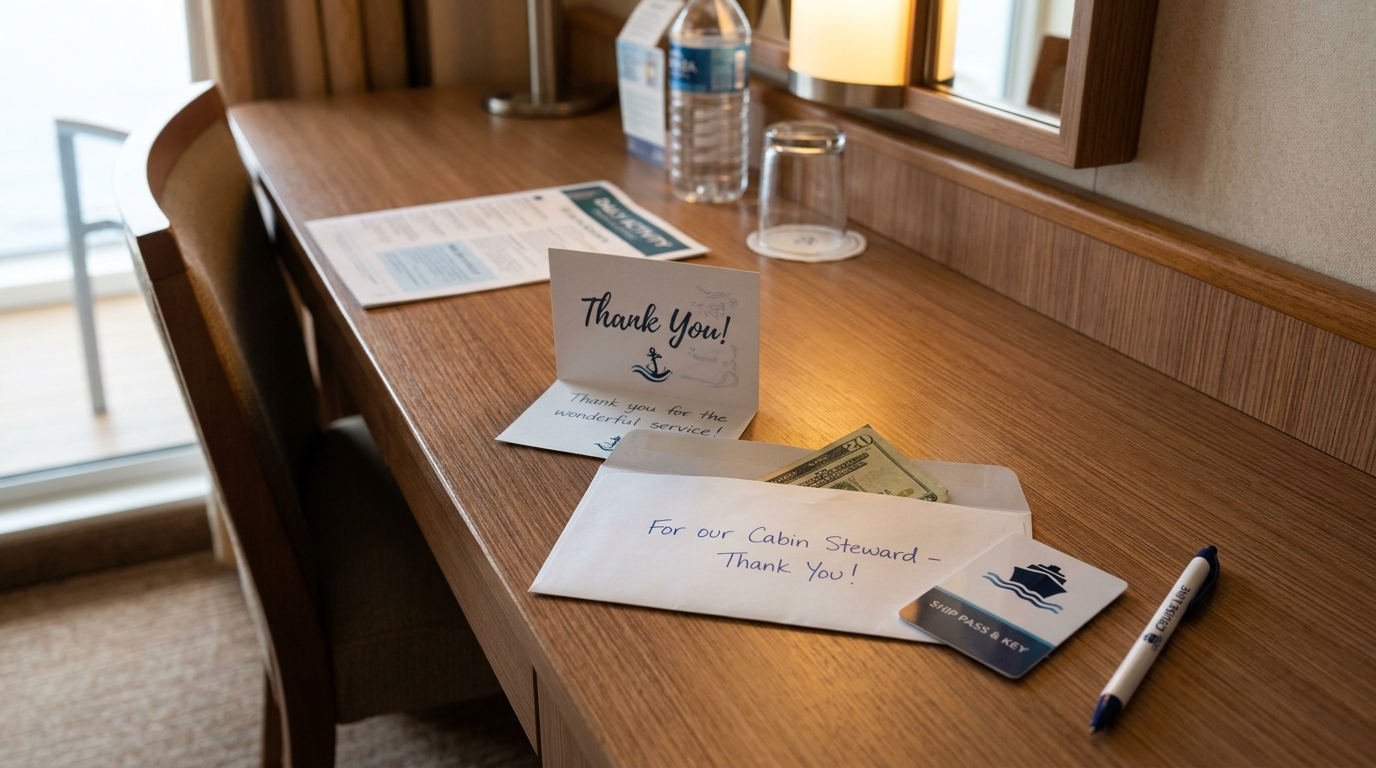
If you wish to offer additional appreciation, check whether crew are permitted to receive it and which currency is practical on that sailing. A thank-you note or a thoughtful compliment submitted through the operator's recognition process can also be meaningful, though it is not a substitute for mandatory charges.
Avoid describing a voluntary extra payment as the only way to receive good service. Crew members should not be put under pressure by passengers expecting preferential treatment, and guests should not feel obliged to pay twice for a charge that was already included.
Children, suites and longer itineraries
When calculating your budget, check the policy for children. Some lines charge every passenger, others have age thresholds or distinctions. Suite guests may have different daily rates due to additional services. A family occupying multiple cabins should confirm how charges are allocated and billed.
Consider a hypothetical seven-night family trip. Even without a bar package or specialty dining, several daily passenger charges can add up to a meaningful total. Write the rates from your actual reservation into a simple table and multiply by passengers and nights. Add separately priced services afterward. Do not compare the resulting figure to a fare that already includes those costs.
If you extend the voyage with back-to-back sailings, verify how charges apply across both bookings. Port days and sea days typically remain days of onboard accommodation, even if you spend many hours ashore; check your fare's stated billing rules rather than making assumptions.
Gratuities ashore follow local expectations
Cruise-operated excursions, independent guides, taxis, porters, and restaurants on land may each have different local customs. Do not apply a ship's onboard charging system to every country you visit. In some destinations, service is included in the bill; elsewhere, additional tipping is customary or appreciated.
Read the excursion description to see what is included and ask respectfully if something is unclear. Bring small-denomination cash if appropriate, but check local currency and practical payment methods. Avoid conspicuous cash handling in busy port areas. If a tour has multiple guides, boat operators, or drivers, understand who is responsible for which part of the experience before offering extra payment.
You do not need to become an expert in every culture overnight. A little destination-specific research and polite questions can prevent both awkward underpayment and unnecessary overpayment.
How to check the onboard account
Most modern cruise ships offer a way to review charges through an onboard app, cabin television, printed statement, or guest services. Review the account early and periodically rather than waiting until disembarkation morning. Verify which purchases are yours, whether prepaid benefits appear correctly, and whether automatic service charges match what you expected.
Keep confirmation emails for dining, Wi-Fi, and drinks packages. If a gratuity was prepaid, retain proof of payment and compare it against the account. Errors are easier to resolve while the relevant transaction and staff are still available. Ask for written confirmation when a billing issue is corrected.
Remember that an onboard account is often linked to a payment card and may include currency conversion or bank fees. Those financial details are separate from crew gratuities but affect the final amount. Check the ship's currency and your card's terms before departure.
If you disagree with a charge
Start with a factual question: what is this item for, where was it disclosed, and is it included in my fare? Show the relevant part of your booking or receipt. Customer-service staff can usually explain whether an amount is an automatic gratuity, a mandatory service fee, or a discretionary tip.
If your complaint concerns a specific service problem, describe what happened, when it happened, and what remedy you are requesting. Escalate appropriately if the initial response is incomplete. Do not assume a disputed charge can be removed under every contract or law, and do not withhold payment based on informal advice from a forum.
After sailing, save your final account statement. It is useful when checking your bank statement and comparing the real cost of cruises in the future. If a transaction seems unauthorized, follow the cruise operator's dispute process and your payment provider's rules.
Build an honest tipping budget
Make a separate line for published daily charges, another for automatically applied service percentages, and a small optional allowance for additional thanks ashore or onboard. Label included amounts clearly so you do not count the same charge twice. This budget can be modest or generous according to your circumstances; its value lies in being accurate.
A cruise should not end with uncertainty about who received your money or why a particular total appeared. Read the booking terms, check itemized receipts, and handle service concerns through the proper channels. Knowing the system ahead of time makes gratitude feel like a choice rather than a surprise expense.
Keep recognition specific and respectful
A genuine compliment is most helpful when it names the service that made a difference. If a crew member handled a dietary request carefully or helped resolve a mobility issue, mention the venue and circumstances through the line's feedback channel. Avoid making assumptions about a staff member's pay, working arrangement or eligibility for personal cash gifts.
Onboard hospitality relies on people in both visible and behind-the-scenes roles. The operator's formal charges may reflect a wider system than a passenger can observe. Understanding that structure can make decisions about extra tips more informed and less emotional. Pay mandatory charges as required, address service problems through proper channels and treat optional appreciation as separate.
Check gratuities before checkout
- Verify the operator’s daily charge per passenger and rules for children.
- Check whether service fees are already included in drink or dining packages.
- Read the current local policy for adjusting gratuities and plan your budget accordingly.


